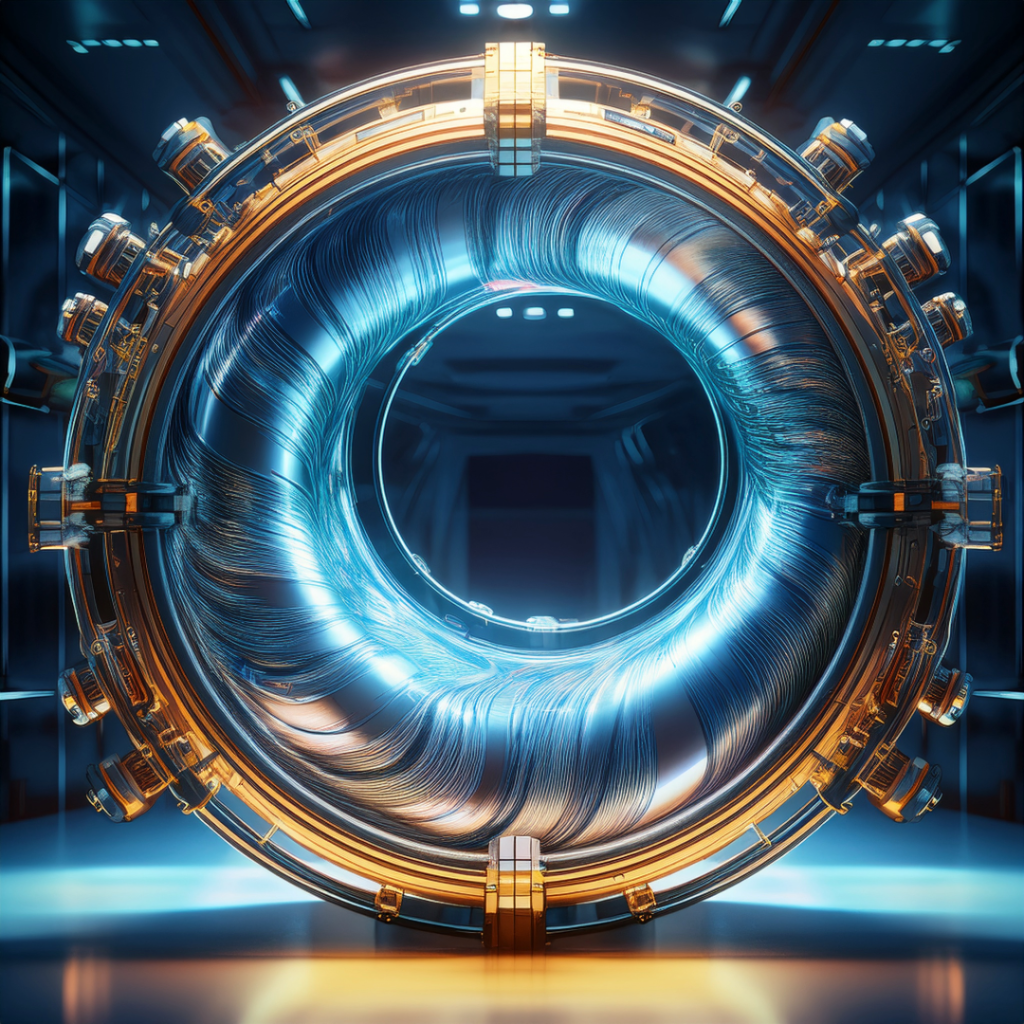
Traditional machines rely on rotating parts, gears, and bearings for movement. However, these systems face issues such as wear, friction, and the need for regular maintenance. But what if we could design a system that uses only the flow of liquid metal, without any moving solid parts? Thanks to magnetohydrodynamic (MHD) liquid metal technology, these futuristic ideas are becoming reality!
Magnetohydrodynamic Liquid Metal Reaction Wheel
Spacecraft use reaction wheels to adjust and maintain their orientation. These systems control the vehicle’s direction by generating angular momentum with disks rotated by electric motors. However, they have disadvantages such as friction, mechanical wear, and energy loss.
A revolutionary new approach replaces traditional reaction wheels with a liquid-metal-based system. Instead of solid rotating parts, electric currents and magnetic fields move the liquid metal to generate torque for attitude control.
This system is based on a liquid metal alloy called Galinstan, which remains in a liquid state at room temperature. Inside a plastic tube forming a circular path, the liquid metal is set in motion by the magnetic field generated by neodymium magnets and the electric current applied through electrodes. The interaction between the electric current and the magnetic field causes the liquid metal to rotate, producing the torque that adjusts the spacecraft’s orientation.
Advantages of This Technology:
• Frictionless operation with no moving mechanical parts
• Long lifespan with minimal maintenance requirements
• More stable attitude control, ideal for space applications
Frictionless and Wear-Free Satellite Control System
One of the biggest challenges in space exploration is minimizing mechanical wear and reducing the need for lubrication. Liquid metal reaction wheels offer a completely frictionless and maintenance-free alternative to traditional satellite control systems.
The liquid metal is hermetically sealed inside a vacuum chamber, while electromagnets guide and control its flow. The system is designed to minimize interaction with Earth’s magnetic field, ensuring precise control.
Key Advantages:
• Requires no lubrication, making it ideal for long-duration space missions
• Reduces micro-vibrations, perfect for space telescopes and sensitive instruments
• Provides better control and fewer mechanical failures thanks to higher accuracy and longer lifespan
Thanks to advancements in magnetohydrodynamic systems, future satellites and spacecraft will achieve greater precision, extended operational lifetimes, and more efficient maneuvering capabilities.
Self-Healing Surfaces with Liquid Metal
Spacecraft are constantly exposed to the threats posed by micrometeoroids and space debris, which can cause serious damage to their outer surfaces. Traditional repair methods require human intervention or complex robotic systems. In deep space missions, these methods are especially costly and impractical.
As a solution, liquid metal coatings have been developed to automatically repair surface damage. Using microcapsule technology, tiny capsules filled with liquid metal are embedded within the spacecraft’s protective layers. When an impact occurs, the capsules break, and the liquid metal spreads across the damaged area. It then solidifies, filling the cracks and restoring the structural integrity of the surface.
Advantages:
• Extends the spacecraft’s lifespan and reduces the need for costly maintenance and repairs
• Enhances safety, especially in deep space missions where repairs are not possible
• Provides continuous protection against micro-collisions, improving structural durability
Orbital Energy Harvesting with Electromagnetic Systems
As the demand for energy sources in space increases, innovative methods for powering satellites without relying on external energy supplies are gaining importance. One promising approach is based on harvesting energy from changes in the magnetic field during a satellite’s orbital motion. This method converts kinetic energy into electrical energy through electromagnetic systems.
Faraday disks integrated into the satellite system are housed within rotating liquid metal containers. As the satellite moves along its orbit, the magnetic field changes, causing the liquid metal to rotate. Through electromagnetic induction, electricity is generated, captured, and stored in batteries.
Advantages:
• Long-term energy solution: Provides sustainable power for satellites with limited access to solar energy or other sources
• Self-sufficient power generation: Satellites can operate without external energy, reducing reliance on solar panels or fuel
• Ideal for small satellites: Faraday disk systems are well-suited for small satellites with space and weight constraints
Nanofluid Cooling and Propulsion System
In satellite operations, managing the heat generated by onboard electronics and propulsion systems is a significant challenge. Traditional cooling methods can be insufficient in the vacuum of space. Therefore, efficient and compact systems capable of providing both cooling and propulsion are needed. As an innovative solution, nanofluid technology has been combined with electromagnetic fields to develop an effective propulsion and cooling system.
In this system, a mixture of ferrofluid and superconducting metal nanoparticles is used as the coolant. The ferrofluid is controlled by electromagnets to both direct the flow and provide propulsion. Heat from the satellite components is efficiently transferred through the nanoparticle suspension, while the same fluid acts as a controlled propulsion mechanism.
Advantages:
• Dual function: Provides both cooling and propulsion, offering a compact and efficient solution for small satellites
• Electromagnetic control: Precisely and efficiently manages fluid flow
• Lightweight and efficient: Ideal for space missions with limited resources due to lower weight and energy consumption compared to traditional systems
Use of Liquid Metal in Space Against Cold Welding
In the harsh conditions of space, the absence of atmospheric pressure can cause metal surfaces to stick together, a phenomenon known as cold welding. This can lead to mechanical failures in satellite components. An innovative solution to this problem is the application of a liquid metal coating between metal surfaces.
During satellite operation, a thin layer of liquid metal is injected between two contacting metal surfaces. This layer forms a barrier that prevents the surfaces from sticking together while also enabling smooth movement.
Advantages:
• Increases spacecraft durability by reducing wear and tear
• Prevents cold welding, thereby avoiding mechanical failures
• Enhances the performance of mechanical systems with the smooth liquid metal surface, resulting in smoother operation and fewer breakdowns
Ferrofluid Magnetic Pumps
Ferrofluid is a suspension of nanoparticles sensitive to magnetic fields within a carrier liquid, making it an ideal material for pump systems without moving parts.
A ferrofluid magnetic pump operates by directing and controlling the fluid using magnetic fields, eliminating the need for traditional moving components like rotors or pistons. This design offers high efficiency, durability, and reliability—especially valuable in space missions where maintenance options are limited.
The key components to realize this concept are: a suitable ferrofluid, electromagnets, and a closed-loop system. The system enables the ferrofluid within the closed loop to be guided by magnetic fields. By adjusting the strength and direction of the electromagnets, the fluid flow is precisely controlled.
Ferrofluid pumps operate silently and minimize maintenance needs, which is a major advantage for vacuum environments and space applications where maintenance is nearly impossible.
Additionally, since they contain no mechanical parts, they are highly energy-efficient; the ferrofluid is controlled directly by electromagnetic forces, consuming less energy and operating with greater precision.
Black Diamond Bearings
Traditional bearings wear out quickly under extreme conditions such as high radiation, temperature fluctuations, and micrometeoroid impacts. Black diamond bearings, made from polycrystalline diamonds, offer an ideal solution by providing superior durability, strength, and precision.
Polycrystalline diamonds are a type of synthetic diamond synthesized under high pressure and temperature, known for their hardness and wear resistance. This material, formed by the rearrangement of carbon atoms into a crystal structure, offers low friction and high mechanical durability.
Prototype Development Process:
• Diamond synthesis: Carbon atoms are transformed into a polycrystalline diamond structure under high pressure and temperature.
• Bearing manufacturing: Polycrystalline diamond is processed into bearings that withstand high stress and friction.
• Integration into spacecraft: Black diamond bearings provide precise movement in mechanical components such as solar panel actuators, robotic arms, and antennas.
Advantages:
• Polycrystalline diamond, one of the hardest materials on Earth, offers superior wear resistance.
• Its smooth surface enables precise control with minimal friction.
• High durability reduces maintenance needs and the risks associated with in-orbit repairs.
• Low friction delivers outstanding performance in satellite orientation and sensitive equipment.
Listen to the podcast here:
Author Omaykan Seyitoglu
 Technology Meets Creativity